HAT and HAT+
A HAT follows the mechanical outline and 40-pin header for Raspberry Pi. An ID EEPROM lets the system load the matching device-tree overlay. This form fits when the product should sit on a Raspberry Pi and stay mechanically predictable.
Electronics and embedded Linux
Product-specific boards for use with Raspberry Pi single-board computers and Compute Modules. Schematic, PCB, ID EEPROM, device tree, and bring-up – and the software around the board when the board is only one part of the device.
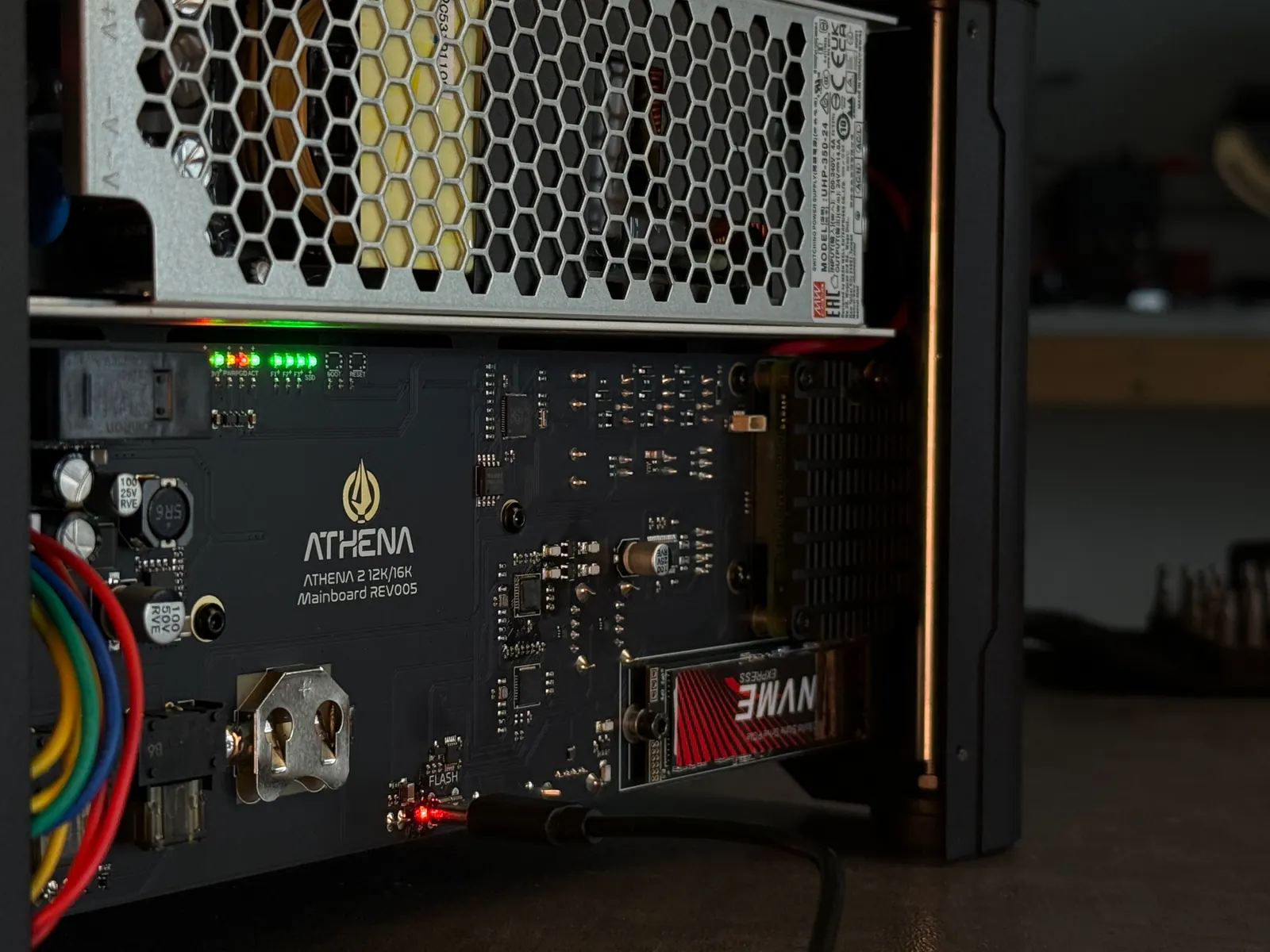
HAT, shield, and carrier answer different mechanical questions. Electrically the job is the same: a board that fits the product and boots cleanly.
A HAT follows the mechanical outline and 40-pin header for Raspberry Pi. An ID EEPROM lets the system load the matching device-tree overlay. This form fits when the product should sit on a Raspberry Pi and stay mechanically predictable.
Shield is the older, looser name for a stackable add-on. We use it when the HAT outline, height, or connector placement does not fit the device – a taller stack, a custom connector leaving the header, or a board that has to clear existing mechanics.
A carrier is the baseboard a Compute Module plugs into. It provides power, storage, Ethernet, USB, display or camera links, and the I/O the product needs. ATHENA’s control electronics are built this way: a Compute Module for Raspberry Pi plus a realtime co-MCU, integrated into the machine.
Jumpers or a catalogue board were enough to prove the idea. The product still needs its own I/O, a defined power tree, or a form that can be manufactured.
Interfaces and the enclosure are sketched. The baseboard that brings the module into the device has not been designed.
It boots unreliably, or power, EMI, or the overlay are not yet solid enough to manufacture.
Mechanics, a local UI, or a backend are part of the product. A bench test on its own does not describe it.
Reference
On ATHENA, Layershift delivers the control electronics around a Compute Module for Raspberry Pi and a realtime co-MCU – including firmware, system integration, and the update path. The product belongs to Concepts 3D. The reference shows how a carrier lands in a connected device.
Yes, when the HAT or HAT+ outline is the right form – including the mechanical grid, 40-pin header, and ID EEPROM. We also design boards that deliberately leave that outline. These are Layershift designs for use with Raspberry Pi, not products of Raspberry Pi Ltd.
A HAT is the specified add-on for the 40-pin header. A shield is a stackable expansion used when that specification does not fit mechanically. A carrier is the baseboard for a Compute Module and replaces the Raspberry Pi single-board computer inside the device.
Yes. Existing schematics, layouts, and images can be reviewed, stabilized, and continued – with a clear read on what is still open.
The board can be the whole engagement. It can equally be the electronics part of a development that includes firmware, a Linux image, and the link to mechanics or cloud.
Current Raspberry Pi boards with a 40-pin header, and Compute Modules. The generation is chosen for the product, not from a fixed catalogue list.
The module, whatever already exists, and what the board has to do in the device are enough for an initial assessment.
Layershift is not affiliated with, endorsed by, or sponsored by Raspberry Pi Ltd. Raspberry Pi is a trademark of Raspberry Pi Ltd.